Hotel u dobrého pastiera — boiler room, guest rooms and a roadmap for the whole valley
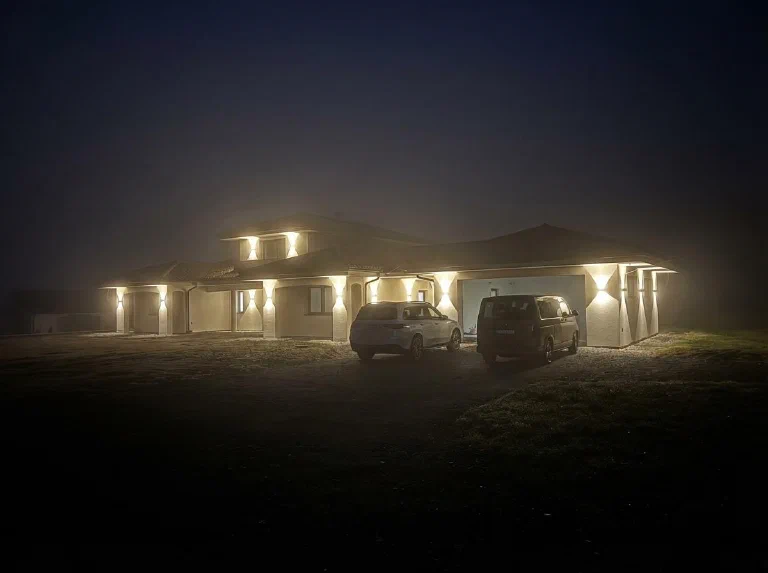
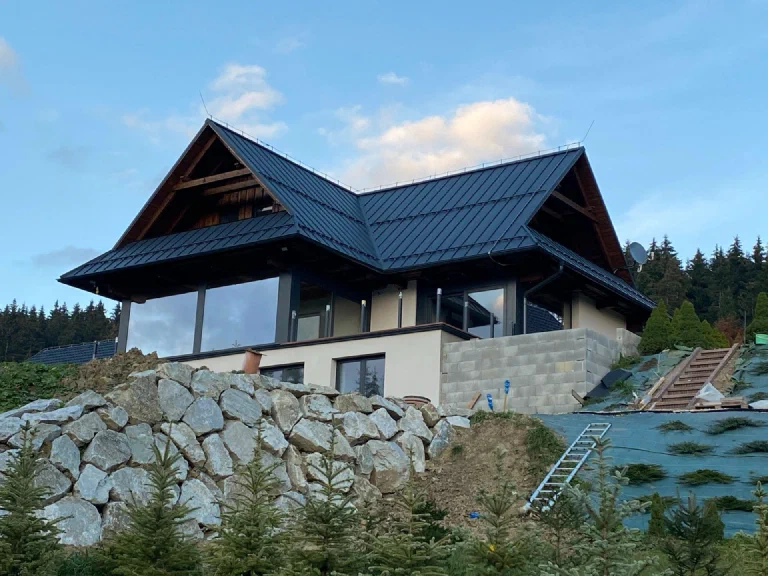
In the Čutkovská valley near Ružomberok stands a mountain hotel — a wooden chalet on a stone base, Goral carved balconies, a private lake above the property and a stream running below the windows. Hotel u dobrého pastiera opened on 1 December 2025 and has been running without intervention in the plant room ever since. This is the story of two TapHome Core units sitting in a single cabinet in the plant room — one for the boiler, one for the rooms — and an engineering principle that, in normal operation, the plant room is meant to look after itself.
The hotel, the valley, the complex

The hotel is part of a wider complex in the Čutkovská valley — alongside the hotel building there is another accommodation building, several restaurants, a wellness area, the Ursus craft brewery and conference facilities. The owner is Černovské drevenice s.r.o.; the main hotel building was constructed in-house by their sister company LSS — Liptovská stavebná spoločnosť to the design of architect Peter Engler.
In this phase TapHome covers the main hotel building — boiler room, HVAC controls (Slovak: MaR) and guest rooms. The complex’s other buildings still run their own boiler rooms on an older third-party platform that has aged badly and is unstable in service. That is precisely the opening for TapHome in Ružomberok — the project has been led from the start with the plan to bring the complex’s boiler rooms onto a single system, building by building.
Lake water — a primary loop
The complex has its own lake above the property. Water flows down to the plant room by gravity through pipes and serves as the primary medium for the 40 kW heat pump. The drop is strong enough that the circulation pump on the primary loop never needs to run — TapHome keeps it wired in as a backup in case gravity flow ever fails.

A plate heat exchanger sits between the primary loop (lake water) and the heat pump itself. Under heavy heat extraction the exchanger is at risk of freezing — and freezing it would be destructive for the entire boiler room. The owner had had bad experiences with flow meters and pressure sensors on previous installations and refused to allow them. CABELLAN therefore built the exchanger’s frost protection purely on temperature sensors before and after the exchanger and a delta-T algorithm: as the temperature gap approaches the critical value, TapHome shuts the heat pump down preventively.
The fault state has two levels. Level 1 stops the heat pump when there is a risk of exchanger freeze-up or another critical fault. Level 2 is a fault state without shutdown — the boiler room can keep delivering heat if another source in the complex is available. That second level is a quiet investment in the roadmap laid out in the next section.
A heat pump without Modbus, via digital I/O alone

The heat pump was supplied only with binary on/off control (0/100 %) — no full modulation control and no practical Modbus path. At 40 kW, a 0 → 100 % step change is hard to stabilise: if the boiler room cannot pull the heat away fast enough, the pump trips into a fault state quickly. Cabellan and HAPA designed the interface differently.
TapHome reads the heat-pump state from a combination of six status signals — discrete digital outputs that the pump also visualises as colour-coded dots on its on-screen schematic. From them TapHome infers when the pump is calling for circulation, when it is in run-down, and when it is signalling a fault. This digital I/O interface has proven reliable in stable operation.
Around the heat pump TapHome runs a set of modulating circulation pumps on 0–10 V — heat extraction into the buffer tank, flow-through DHW heating via a plate exchanger, transfer into the DHW cylinder, distribution into underfloor heating, into fan-coils and into the cooling loop. Other pumps switch on/off, three-way mixing valves split the hydronics into circuits, and a network of NTC sensors continuously senses temperatures across the boiler room.
Guest rooms — open the window, the heat pulls back

The distribution side — heating and cooling in each room — was programmed by HAPA, s.r.o. from Oravský Podzámok, Cabellan’s long-time partner from low-voltage, CCTV and security work. The programmer is Ján Holubčík, the field technician is Martin Gerek.
The hotel has 19 guest rooms and 6 mezzanines — 25 heating and cooling zones in total, with 24 dedicated heating zones (mezzanines occasionally share a zone with the attic room above them). Every room carries its own multi-zone controller with a display and a 6 UI / 6 UO module with switching relays in the in-room cabinet. Electric underfloor heating is switched through relays from the in-room cabinet; fan-coils handle both heating and cooling and are integrated over Modbus.
A few touches that meet the guest every day:
- Magnetic window contacts. When a guest opens a window, TapHome receives the signal and the heating or cooling for that zone shuts off automatically. Heating with an open window is ruled out.
- Bathroom towel rail. Activated for a fixed time — the guest turns it on, the towel warms up by morning, the rail switches itself off. Nobody can leave it running.
- Reception master mode. Reception has a console display through which the staff sets occupancy, switches each room between occupied / vacant and, where needed, allows or blocks the guest from touching the thermostat. In a vacant room TapHome automatically pulls energy use down.
Physically, every module from all 19 rooms is centralised in the main cabinet in the plant room. Reception holds only a control console — no relays, no I/O modules, only the interface. Staff work the entire hotel from one screen, while the physical infrastructure stays under lock and key in the plant room.
A pre-Christmas commissioning
Installation began in June 2025 and the deadline was 1 December 2025 — the first guests could not be moved, and the moment the hotel opened, the boiler room could no longer be taken offline. Cabellan and HAPA pushed it through under the wire — some decisions remained as compromises under deadline pressure. Inter-Core communication between the two TapHome Cores in the cabinet, for instance, runs through relay links as a quick fix, and fine-tuning the automatic switch into cooling mode was deferred to the first summer — outdoor temperatures in December simply did not allow a realistic cooling test.


Roadmap — the whole complex on a single system

This is where the project turns from a hotel reference into an infrastructure vision. The complex is hydraulically looped — every boiler room (hotel, kolibas, wellness, the Ursus brewery) is interconnected through pipework. The goal is for the boiler rooms to share heat between each other: when one cannot keep up or is in fault, its neighbour delivers the surplus. TapHome is already prepared for that strategy today through the two-level fault state (Level 2 = fault without shutdown — the boiler room continues from an external source).
The next phases will be incremental — installing additional TapHome Core units in each building’s boiler room, moving the inter-Core communication from relay links to Modbus TCP, remote control of the Ursus brewery with local safety overrides, and gradually replacing the older platform across the rest of the complex.
Team and delivery
| Role | Company |
|---|---|
| TapHome general contractor — boiler room and HVAC controls | CABELLAN, s.r.o. — Martin Šustr |
| Programming of in-room heat distribution | HAPA, s.r.o. (Oravský Podzámok) — Ján Holubčík (programmer), Martin Gerek (field technician) |
| Hotel owner | Černovské drevenice s.r.o. |
| Construction | LSS — Liptovská stavebná spoločnosť |
| Architect | Peter Engler |