House in Horehronie — smart home with room to grow
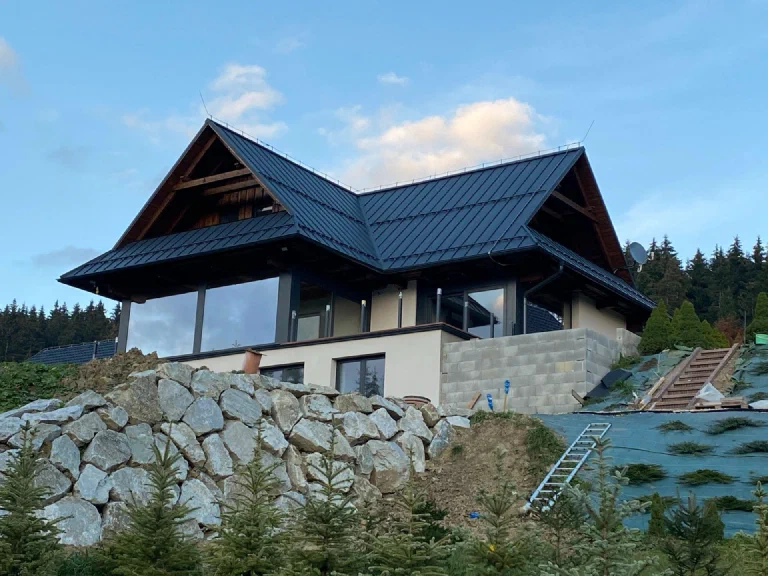
The owner came in with a clear idea: “We buy cars fully loaded — and houses should be fully loaded too.” On the build of a 300 m² family house in Horehronie, this philosophy drives every decision. Construction began in 2022, the family is moving in this year, and a wellness with a swimming pool will be added at the back of the plot by 2030. TapHome runs this staged journey — one Core, two in-wall cabinets, and infrastructure ready for everything still to come.
Technical room as the foundation

Two EATON 144-module cabinets are flush-mounted into the wall of the technical room, one above the other, with low-voltage strictly separated from high-voltage. CABELLAN installed them during the shell phase — the technical room is used by the whole family, so the cabinets had to be installed and covered with care.
At the heart of the installation runs one TapHome Core and a set of IO modules: six 32UI, twelve 12DO, one combined DO12UI12, five 4UI2DO, 6UI, 2UI, one LEDOC4, two LEDOC12, 4DIM and a Wiegand gateway W2DI2DO2. Together with 25 relays and a 24 V 150 W power supply.
The heat source is a VIESSMANN Vitocal 200-G — a ground-source heat pump with a combined buffer tank also tied to the fireplace circuit. “The fireplace will only heat at Christmas, when the family is together,” the owner clarifies. From the tank the cabinet operates 12 heating zones: underfloor heating throughout the house, three radiators in the garage, and three towel rails in the bathrooms. The garage has a dedicated temperature sensor that TapHome uses to control the circulation pump.
The house runs on its own well with a water treatment system. Against water leaks, five wired TapHome flood sensors are wired in (bathrooms 2×, laundry 1×, boiler room 1×, fireplace piping under the stairs 1×) plus one wireless Paradox sensor in the kitchen, where no cable had been pre-run.

Infrastructure ready to grow

Every cable has its colour and its place. Orange for low-voltage, yellow-green for earth, purple for the bus. Heating manifolds are labelled by zone — kitchen, living room and two large ground-floor hallways merged into a single zone, the rest (office, entrance hall, dressing room, four bedrooms, laundry and bathrooms) run independently.
Honest preparation is why nothing slows this house down as it grows. The 144-module cabinets keep spare capacity for the planned wellness with pool in 2027–2030, for two Victron Energy photovoltaic systems (one for the house, one separately for the wellness), and for the installed HIKVISION cameras, whose person-recognition signals feed into TapHome to trigger the alarm or exterior lighting and scale back irrigation while the family is in the garden.
30 luminaires the owner installed himself
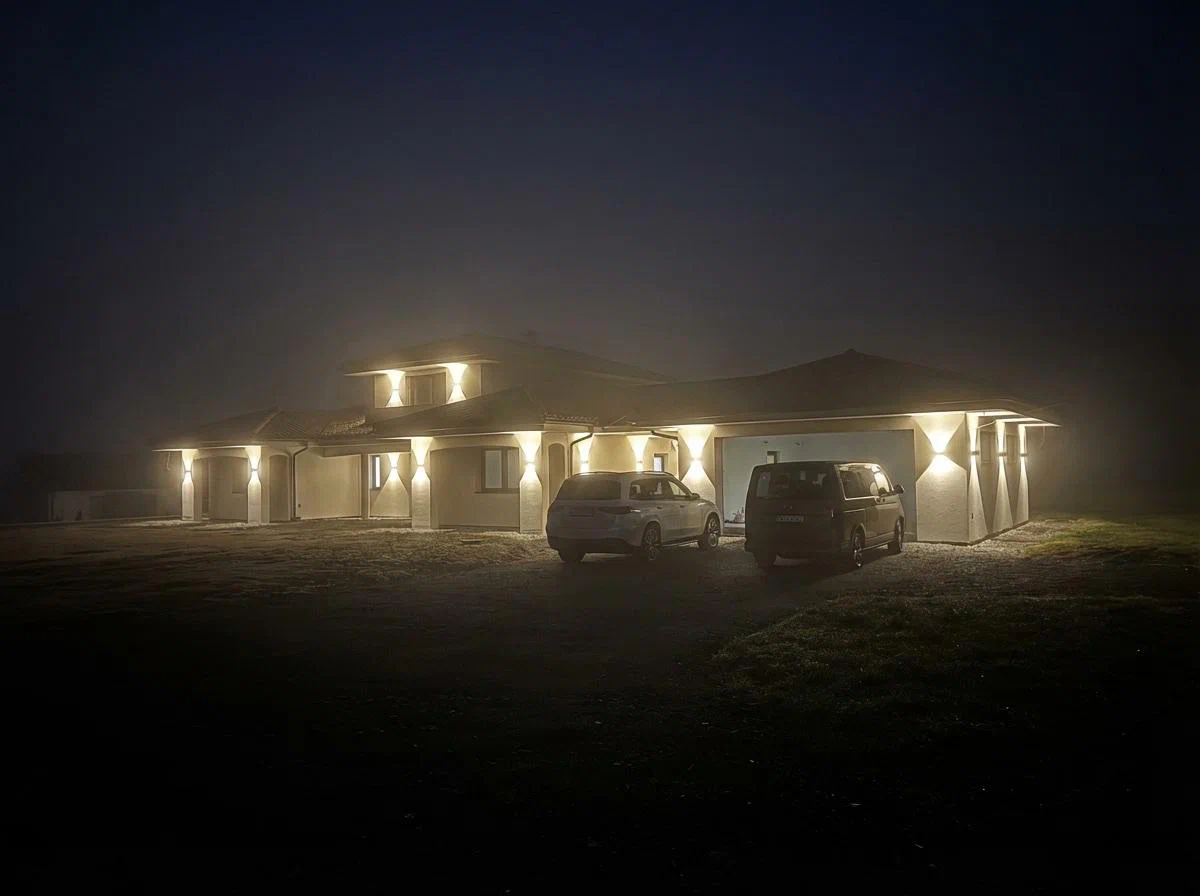
The owner is not a typical customer — he is a perfectionist who directs the build himself. He picked 30 EGLO CALPINO 3 facade luminaires (2.8 W LED) and mounted and terminal-wired all 30 of them himself. Martin Šustr from CABELLAN then brought them online in TapHome.
“The owner is a real perfectionist and did it thoroughly and to showroom standard — including the terminal wiring. He takes on the peripheral work so I can focus on the more specialised parts.”
— Martin Šustr, CABELLAN s.r.o.
This kind of collaboration — the installer comes in for two- to three-day stints while the owner prepares the routine tasks in between — is a practical model for large, long-running projects. The lighting logic and scenes will be programmed gradually after move-in, when there is time to work on site with the residents’ feedback.
Light as design

The house has 32 separate lighting circuits — spotlights in the vaulted soffits, RGB strips under the kitchen island and bar, an LED staircase with sequentially switched treads, LED ceiling frames in the bathrooms and social spaces, and lit niches in marble showers. Dimming and PWM control of the LED strips run through 4DIM, LEDOC4 and two LEDOC12 modules.


The interior builds on contrasts — light marble and black details, warm light and room for colour in the kitchen and bar. Shower niches, the LED frame running along the ceiling, and the soft glow on the staircase can all be controlled separately, through scenes or by time of day.
At least six year-round scenes will be added to the garden this year: practical lighting for walkways, accent lighting for trees, and circuits for Christmas lighting (8 outdoor outlets are already run).
Connected systems, today and tomorrow
Shading. Sixteen zones of exterior blinds, tied to the weather station with automatic response to sun. Motors are being sourced.
Windows. Twenty automated windows for controlled ventilation, driven through TapHome.
Audio. Six audio zones with individual radio and volume control (kitchen, dining area, office, two bathrooms, laundry), powered by Fonestar amplifiers in a KELINE rack. The living room has a separate HiFi system with an outdoor feed to the terrace. In the central dining area sits a 27″ touch monitor that brings together the TapHome app, internet radios and photo browsing from the network drive. Audio runs autonomously for now — full integration into TapHome is planned for the next phase.
Air conditioning. Three Viessmann split units run as a standalone system; we will add TapHome control in the next phase.
Switches. The black two-button NIKO switches were chosen by the owner during the 2021 design, when TapHome had no touch switches of its own yet. Some rooms have been locally supplemented with 4UI2DO modules. The new wellness spaces (2027–2030) will already use TapHome touch switches.
Security. The Paradox alarm and HIKVISION cameras are fed into TapHome: triggering exterior lighting on motion, pausing irrigation when the cameras detect the family in the yard, and linking into the alarm zone.
Phasing as a concept
The house has been growing for four years and will likely be fully finished in 2027–2028. The wellness with swimming pool will be added at the back of the plot in the 2027–2030 phase. Spare capacity in the system for future expansion, TapHome Core as the central intelligence, and the modular philosophy of the system mean that every new phase plugs in without anything having to be rebuilt. For CABELLAN this is a project that grows with the client — and for the client it is a house that matures with him and gradually gains new functions.
“The best projects are the ones where you can dream with the client — adding things to the system together that didn’t even cross their mind before.”
— Martin Šustr, CABELLAN s.r.o.