
Energy Manager: steady switching when the grid meter reading swings
Devices controlled by the Energy Manager would follow the real surplus, not every short swing of the grid meter that a hybrid inverter with a battery causes: no start of the next device on a one-second peak, no switch-off on a short dip, and overload protection still at once.
Why and how you would use it
The Energy Manager decides from the grid electricity meter: when there is enough surplus, it turns on the next device, and when the house imports too much, it turns one off. That works well when the meter reading is steady. With a hybrid inverter and a battery it often is not: the inverter keeps correcting the grid exchange, and the reading can swing by several hundred watts within a few seconds.
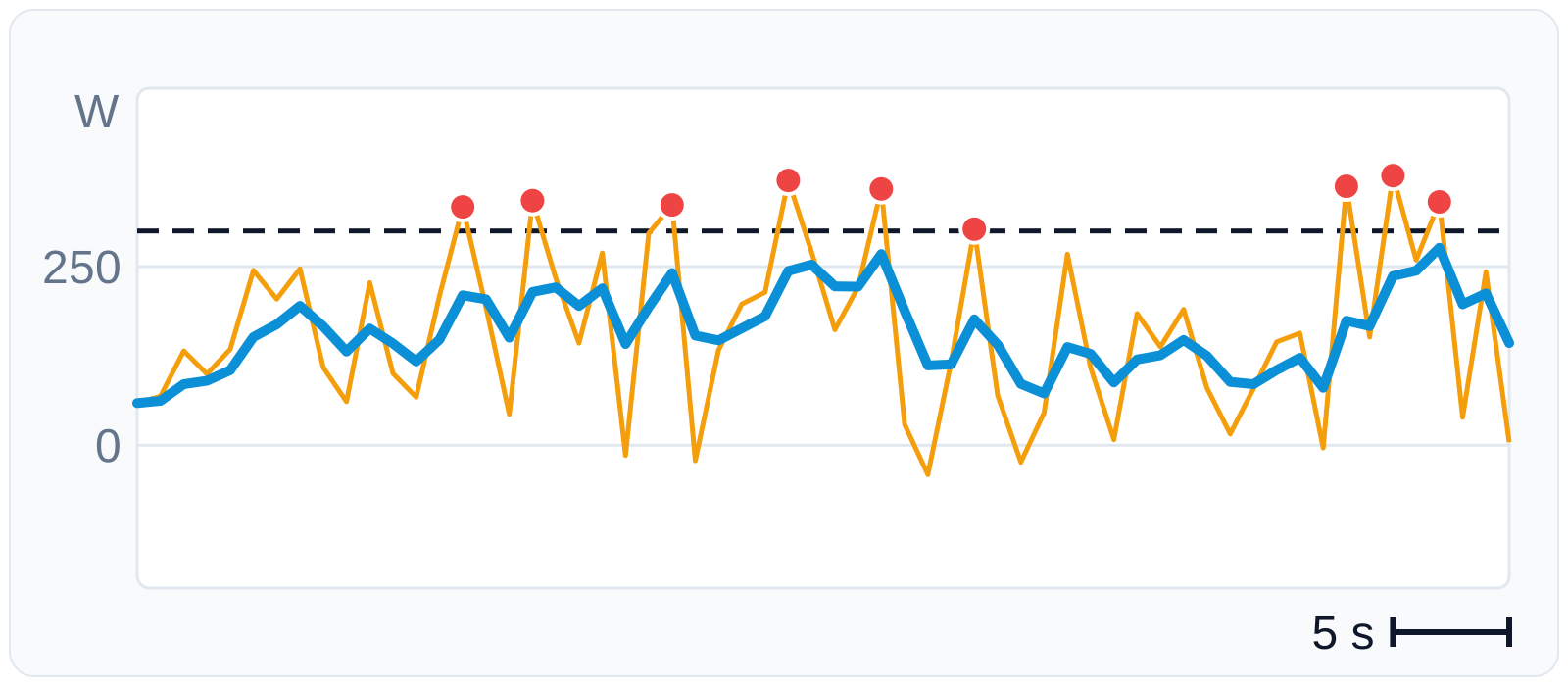
A typical case: three heating elements should start one after another, each only when the previous one is at full power. The real surplus sits around 200 W, then jumps to 250 W for one second. That short peak is enough for the Energy Manager to turn on the next element, and ten seconds later it turns it back down, because the surplus was never really there. Over ten minutes, one element switched on three times and another four times. The installer wants the devices to follow the real surplus, not every swing of the inverter.
The chart shows the problem. The orange line is the meter reading taken every second, the blue line is the real trend of the surplus. Each red dot is a moment when a single short peak crossed the switch-on power (the dashed line) and could turn on the next device, although the trend never got there.
| Today | With this idea | |
|---|---|---|
| Short export peak | Next device starts | Ignored |
| Short import peak | Device turns off | Ignored |
| Overload | Instant reaction | Instant reaction |
What will be possible
We are evaluating this idea. Nothing below is scheduled yet, and how exactly the Energy Manager would tell a short swing from a real change is still open.
- Devices start only on real surplus. A peak of a second or two would no longer turn on the next device.
- Devices keep running through short dips. A short import peak would no longer turn off a device that has met its minimum runtime.
- Calm regulation of analog outputs. EV chargers, heating elements and other analog devices would follow the real surplus instead of chasing every swing.
- Overload protection without delay. The maximum imported power limit would still react at once when the grid connection is overloaded.
- Existing rules unchanged. Energy Manager rules that work well today would keep behaving as they do.
What will not be possible
- Ignoring a swing and reacting instantly at the same time. To tell a short swing from a real change, the Energy Manager has to wait a moment. Devices would react a few seconds later to real changes, for example when a cloud passes, and a little more power could go to the grid before a device starts.
- Better data than the meter gives. The Energy Manager can only work with the readings the meter delivers and as often as it delivers them.
- A calmer meter in the rest of TapHome. The meter device, its history and other smart rules would keep the real readings.
- A different behavior for each device in a first version. The behavior would apply to the whole Energy Manager rule.
How to solve it today
Today the Energy Manager reacts to every meter reading. These settings reduce unwanted switching:
- A wider gap between switch-on and switch-off power. A switch-off power of a few hundred watts instead of a few watts keeps a device running through short import peaks.
- A higher switch-on power for lower-priority devices. The next device then starts only when a larger surplus is left, and smaller surplus goes to the device with higher priority.
- Longer preparation time and minimum runtime. They limit how often the same device switches on and off.
- An average in the meter’s read script. For a meter connected through a Modbus or Packet Parser template, a device variable keeps its value between readings, so the read script can return a running average. Create a device variable
Avgwith an empty value and, with the present read expression in place ofreading, write the script asAvg := IF(ISNAN(Avg), reading, Avg + (reading - Avg) / 3); Avg;. The first reading starts the average, and an unknown reading cannot block it for good. With a reading every second this follows roughly the last few seconds. The maximum imported power limit and the meter history then also see the averaged value, so overload protection reacts a few seconds later.
Learn more
- Energy Manager documentation: power settings, preparation time, stabilization and the maximum imported power limit.
- Module and device variables in TapHome scripts.
Does your meter swing too, with a hybrid inverter, a heat pump or something else? Vote for this idea, follow it for updates and answer the poll below.
Related
Status history
- Nov 4, 2026 Gathering interest Published
Comments 0
Sign in with your TapHome account to comment. The team approves comments before they appear.
No comments yet.
·
The original comment was deleted.
Ideas describe direction, not commitments. We do not publish dates; released features are announced in the release notes.
Sign in with your TapHome account to follow. We email you when something changes; unsubscribe in one click.
Confirming your vote…