Equithermic regulation
Equithermic regulation is a simple method for calculating the temperature of the heating or cooling medium in the primary circuit based on the outdoor temperature.
Equithermic regulation
Equithermic regulation is a simple method for calculating the temperature of the heating or cooling medium in the primary circuit based on the outdoor temperature. In most cases, this function is controlled by the boiler or heat pump.
If the curve is configured correctly, it should be possible to achieve the desired temperature in zones with the lowest possible medium temperature (in heating mode) or the highest possible medium temperature (in cooling mode).
A drawback of this method is that it does not have a built-in automatic correction mechanism. If the equithermic curve is not set correctly, it can lead to insufficient or excessively intensive heating/cooling in the zones.

Heating and cooling control
| Aspect | Heating | Cooling |
|---|---|---|
| Inputs | - Outdoor temperature - Zone temperatures | - Outdoor temperature - Zone temperatures - Zone Humidity |
| Output | - Setpoint of the virtual thermostat for the primary circuit | - Setpoint of the virtual thermostat for the primary circuit |
| Limits | - Minimum / maximum configured value | - Minimum / maximum configured value - Dew point (early warning) - Calculation of the minimum setpoint based on the highest relative humidity from all connected zone thermostats |
| PID correction | ❌ | ❌ |
More information about heating/cooling modes
How the final setpoint is calculated
The equithermic curve returns the temperature of the circulating water based on the outdoor temperature. The curve angle, parallel shift, temperature limits, and adjustments based on thermostat data influence the final result.
Angle
For underfloor heating systems, values between 0.2 and 0.8 are commonly used. Lower values are more suitable for buildings with high-quality insulation. The following table shows the resulting setpoint based on outdoor temperature and the curve angle:
Outdoor temperature
| Angle | -20°C | -15°C | -10°C | -5°C | 0°C | 5°C | 10°C | 15°C | 20°C |
|---|---|---|---|---|---|---|---|---|---|
| 0.2 | 33 | 32 | 32 | 30 | 29 | 27 | 24 | 22 | 20 |
| 0.4 | 42 | 40 | 38 | 36 | 33 | 30 | 27 | 24 | 20 |
| 0.6 | 50 | 48 | 45 | 41 | 37 | 33 | 29 | 25 | 20 |
| 0.8 | 59 | 56 | 52 | 47 | 42 | 37 | 31 | 26 | 20 |
Example: If the outdoor temperature is 0°C and the equithermic curve angle is 0.6, the resulting setpoint is 37°C.
Parallel shift
Increases or decreases the curve by a defined value.
Example: If the temperature set based on the curve angle is 37°C and the parallel shift is set to 4°C, the resulting setpoint is 41°C.
Adjustments based on data from thermostats
All zone thermostats that are connected to the equithermic Smart Rule affect the final result.
| Heating | Cooling | |
|---|---|---|
| Setpoint from zones | The equithermic curve shifts upward if the highest setpoint of zone thermostats is greater than 22°C | The equithermic curve shifts downward if the lowest setpoint of zone thermostats is less than 22°C |
| Result | Resulting setpoint = Setpoint based on angle and parallel shift + Proportional value * (highest thermostat setpoint - 22) | Resulting setpoint = Setpoint based on angle and parallel shift + Proportional value * (lowest thermostat setpoint - 22) |
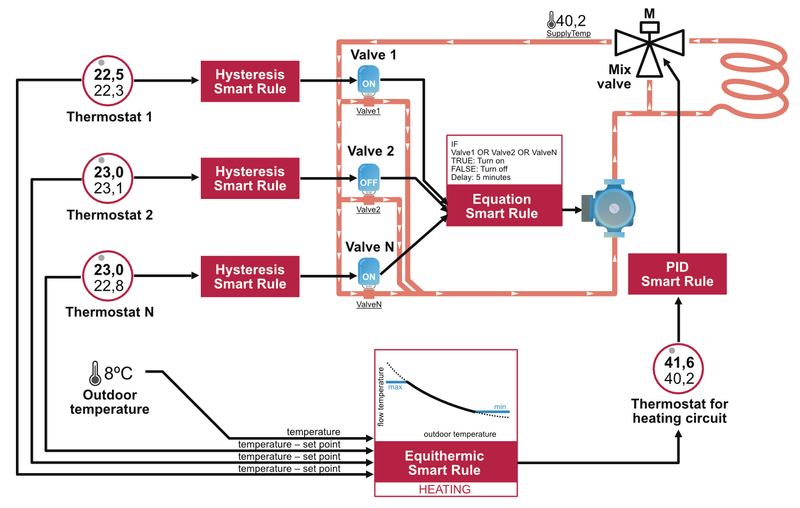
Example scenario for zoned hydronic heating with equithermic regulation
Dew point protection in cooling
When the equithermic Smart Rule runs in cooling mode, it actively protects connected zones from condensation by dynamically clamping how cold the primary-circuit setpoint is allowed to go. This safety mechanism is called dew point protection and is one of the limits shown in the heating/cooling control table above.
Why dew point protection matters for hydronic cooling
Chilled water that is colder than the dew point of the surrounding air causes moisture to condense on pipes, manifolds, fan-coils and radiant ceiling panels. Visible results are dripping surfaces, puddles on the floor and long-term damage to plaster. Preventing condensation is the single most important safety feature of any hydronic cooling installation — and equithermic regulation configures it in one place, at the primary-circuit level, for all downstream zones.
How dew point protection works
- Each zone thermostat (or a dedicated air humidity sensor) reports relative humidity and temperature for its zone.
- The equithermic controller picks the highest relative humidity across all connected zones and uses it together with the zone temperature to compute the current dew point of that zone’s air.
- The primary-circuit setpoint is clamped above the dew point plus a configurable safety offset. If the equithermic curve would otherwise demand a colder chilled-water temperature, the controller overrides the curve and holds the setpoint at the dew point + offset instead. This is the early warning behaviour listed in the cooling limits table.
Configuring dew point protection
In the Dew point group of the equithermic Smart Rule you configure:
- Dew point adjustment (%) — how far above the calculated dew point the minimum setpoint sits. Higher values mean a larger safety margin against condensation, but reduce peak cooling performance.
- Humidity source — relative humidity can be read from the connected zone thermostats or from additional air humidity sensors. When multiple sources are present, the highest relative humidity value is used for the dew point calculation.
What you need to enable dew point protection
- At least one source of relative humidity per cooled zone: either a zone thermostat with an integrated RH sensor, or the Air Humidity and Temperature Sensor connected to the EXT terminal of a 2UI / 6UI / 6UI6OC / 4UI2DO bus module.
- A zone temperature reading from the same zone (typically the same thermostat).
- The equithermic Smart Rule configured in cooling mode with zone thermostats linked to it.
When to enable dew point protection
Always enable dew point protection for hydronic cooling — chilled water distributed through underfloor loops, fan-coils or ceiling cooling panels. The only scenario where it is not needed is purely air-based cooling (e.g. split A/C units controlled over IR), where there is no cold water surface to condense on.
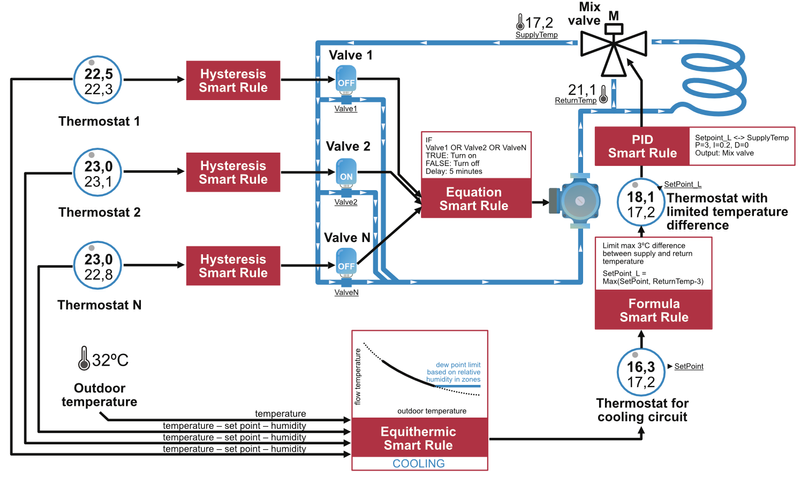
Example scenario for zoned hydronic cooling with equithermic regulation